

If you are an Indian student planning a Master’s in Germany, there is one more step waiting for you now. Along with your APS certificate, you will need to take a new test called the Digital Master Test (dMAT) often referred to as dMAT India since it is rolling out for Indian applicants first. It kicks in from the Summer Semester 2027 intake, and for now only for specific fields.
I know, one more thing on the list. But it is not as scary as it sounds, and once you understand what it actually is, you will see it is more of an extra step than a wall. Let us go through everything you need in one place.
Quick backstory: why the dMAT India test exists
You already know APS (Akademische Prufstelle, or Academic Evaluation Centre), the body that verifies your Indian academic documents before you apply to a German university. It was set up in October 2022 as a joint initiative of the German Embassy in New Delhi and DAAD, and since November 2022 an APS certificate has been compulsory for almost every Indian student going to Germany.
Until now, APS mostly checked that your degree and marksheets were authentic and formally in order. The dMAT is a new second layer for Master’s applicants in specific fields. Indian degrees vary a lot in grading and rigour across universities, and German admissions offices needed a shared yardstick to compare applicants fairly. That is the whole idea behind dMAT India. It is a common reference point, not a filter designed to keep you out. If you are still figuring out the bigger picture, our Studying in Germany guide covers the basics, universities, degrees, and language requirements.
What is the dMAT?
The Digital Master Test (dMAT) is a standardised academic aptitude test for Master’s applicants. It is run by g.a.s.t. (Gesellschaft fur Akademische Studienvorbereitung und Testentwicklung), the same organisation behind TestDaF and was developed with the Universities of Ulm and Kassel, with early support from DAAD.
From 2026, the dMAT sits inside the APS documentation for Indian Master’s applicants in selected fields. It does not replace APS document verification. Your APS certificate still comes from APS India the usual way; your dMAT result simply travels with it.
Who has to take the dMAT (and who doesn’t)
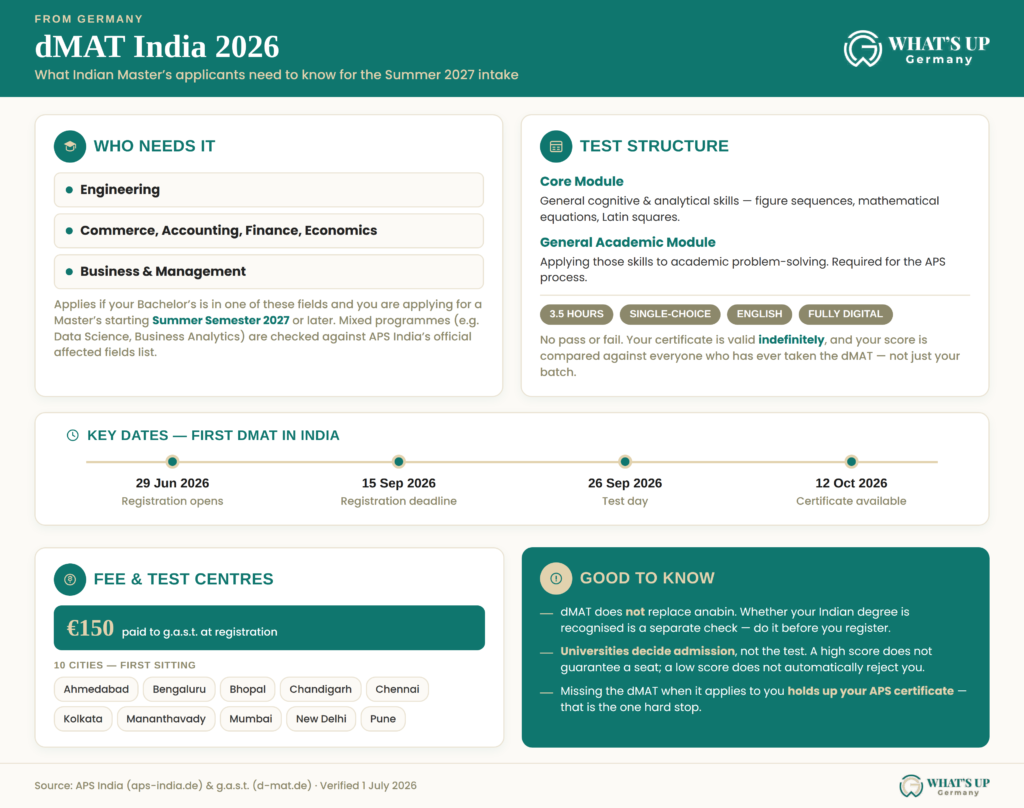
The dMAT India rule applies to you if your Bachelor’s is in one of these fields and you are applying for a Master’s starting Summer Semester 2027 or later:
Engineering
Commerce, Accounting, Finance, Economics
Business, Management
If your Bachelor’s is a mixed programme like Engineering Management, Business Analytics, Industrial Engineering, Data Science, or Financial Technology, the final call is made by the official dMAT Affected Fields List published by APS India. If your programme is on that list, dMAT applies to you.
You do not need dMAT if you are applying for a Bachelor’s in Germany, if you are a Bachelor’s student who has not finished at least 5 semesters (3-year programme) or 7 (4-year programme), if you are a PhD applicant, if your Bachelor’s is outside the listed fields, or if you are in an officially confirmed exchange, double-degree, or partnership programme.
There are also transitional exemptions worth knowing: if you completed your APS online registration before 29 June 2026, or shipped your complete APS documents before that date, or already have a completed APS certificate, you are exempt for that procedure. If you file a fresh APS application later, the rules valid at that time will apply.
How the dMAT is built and scored
The dMAT has two modules, all single-choice, in English, taken fully digitally at licensed g.a.s.t. test centres. The whole thing lasts about 3.5 hours, with a break between modules.
The Core Module measures general cognitive and analytical skills through three subtests: figure sequences, mathematical equations, and Latin squares. The General Academic Module (the one required for the APS process in India) tests how well you can apply those skills to academic problem-solving. Both are about thinking, not memorising.
Your certificate shows results on two scales: a percentile rank (what percentage of test-takers scored the same or lower than you) and a dMAT score on a 0-200 scale where the average is 100. Both are shown for each module and added into a total. Since the dMAT is standardised, your score is always compared against everyone who has ever taken it, not just your batch. Also good to know: there is no pass or fail, and the certificate is valid indefinitely.
dMAT India: dates, fee, and test centres
Here is the schedule for the first dMAT in India:
29 June 2026 — Registration opens
15 September 2026 — Registration deadline
26 September 2026 — Test day
12 October 2026 — Certificate available on the g.a.s.t. portal
The fee is EUR 150, paid to g.a.s.t. at registration. For the first sitting, the test will be offered at selected centers in Ahmedabad, Bengaluru, Bhopal, Chandigarh, Chennai, Kolkata, Mananthavady, Mumbai, New Delhi, and Pune. Booking is first come, first served. APS India cannot reserve a seat for you.
How the dMAT fits into your APS file
Your dMAT certificate is issued by g.a.s.t., not APS India, and you submit it together with your APS documents. Your APS certificate will reference your dMAT result once it is issued. APS India can only complete your APS procedure after the dMAT certificate is in. One small flexibility: if you registered for APS on or after 29 June 2026 and dMAT applies to you, you can ship your other APS documents first and add the dMAT certificate later. Everything else on the APS checklist still has to be there upfront.
One thing I really want to underline – the dMAT does not replace anabin. Whether your Indian university and degree are recognized (H+, H+/-, H-) is decided by anabin, not by any test. A great dMAT score cannot fix a degree from a non-recognized institution. Check your institution’s status on anabin before you register
German universities decide, not the test
This is the part I most want you to hold on to: the dMAT does not decide your admission, and neither does APS. Every German university runs its own admissions process, using its own criteria. Your dMAT score is one more input on your file. Some universities may weight it heavily, others might barely glance at it. Most will still care about your Bachelor’s grades, your CV, your statement of purpose, your language proof (if required), and your fit with the programme.
So do not treat dMAT as make-or-break. A high score does not guarantee admission anywhere. A low score does not automatically reject you either. Missing the dMAT (when it applies to you) will hold up your APS certificate and that is the only hard stop in the equation. Keep working on the rest of your application with the same care you always have.
If you want to prepare, g.a.s.t. has free sample tasks, solutions, and short intro videos for each subtest on the official dMAT site. Since it is a digital test with no detailed instructions shown on test day, do every sample task at least once. Familiarity with the on-screen interface saves real time.
(AI tools may be used in writing this piece)
Share this post: