

Prefer video? Rushikesh from WhatsUp Germany covered this on Finance Friday — watch the reel at instagram.com/p/DV1NKwtCPVa
Your first German payslip arrives. You open the PDF. And suddenly you’re staring at words like Steuerrechtliche Abzüge, SV-rechtliche Abzüge, and lfd — wondering where half your salary disappeared.
Good news: every Gehaltsabrechnung follows the same structure. Once you know the 3 zones and a handful of abbreviations, you can read any German payslip in minutes — no German degree required.
What Is a German Payslip Called?
Your payslip can arrive with several different titles. They all mean the same thing:
- Gehaltsabrechnung — most common, literally “salary statement”
- Lohnabrechnung — “wage statement”
- Entgeltabrechnung — the official legal term
- Verdienstnachweis — “earnings proof”
Different HR software, same document. Don’t let the name confuse you.
Your German Payslip Has 3 Zones
Every Gehaltsabrechnung — regardless of company, software, or industry — follows the same top-to-bottom logic:
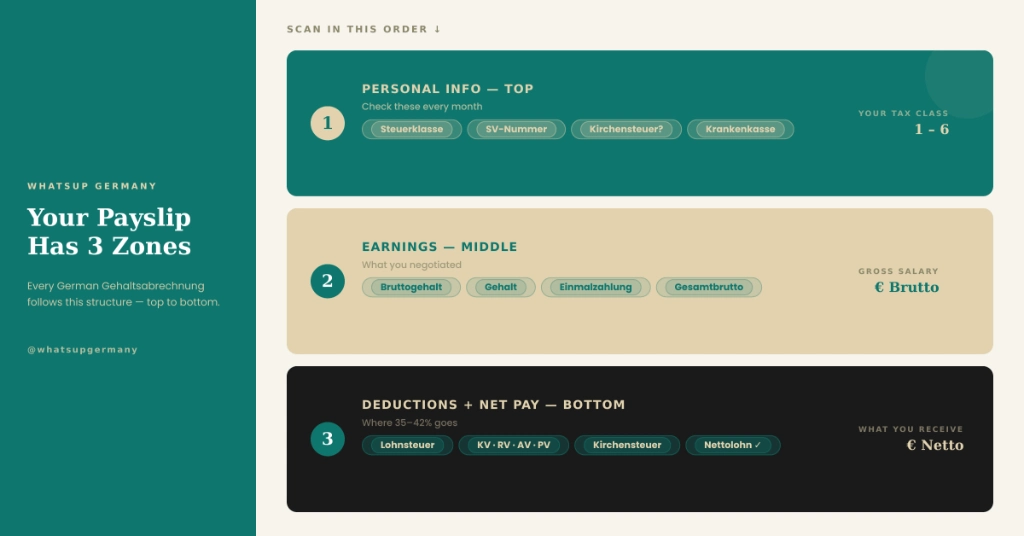
The 3 zones of every German Gehaltsabrechnung. Source: WhatsUp Germany (@whatsupgermany)
Zone 1 — Top: Your personal and tax information.
Zone 2 — Middle: Your earnings — what you negotiated, including bonuses.
Zone 3 — Bottom: Where the money goes — taxes, social security, and your final Nettolohn.
Zone 1: Your Personal Info — Check These Every Month
The top section looks like admin. It is the most important section. These codes directly control how much tax gets deducted.
Steuerklasse (StKl.) — Your Tax Class
This is the biggest lever on your monthly take-home pay. Germany has six Steuerklassen:
| Class | Who it applies to |
| 1 | Single, divorced, or separated |
| 2 | Single parent |
| 3 | Married, higher earner (paired with Class 5) |
| 4 | Married, both earning similarly |
| 5 | Married, lower earner (paired with Class 3) |
| 6 | Second job |
If your Steuerklasse is wrong, you are overpaying tax every month — or building up a bill for January. Check it now, especially after marriage, separation, or starting a second job.
Sozialversicherungsnummer (SV-Nummer)
Your German social security number. This links every pension contribution to your official record at the Deutsche Rentenversicherung. If it’s missing or wrong, fix it with HR immediately.
Konfession / KiSt. — Are You Paying Church Tax?
If you see Kirchensteuer on your payslip and you are not a member of a Catholic or Protestant church in Germany — contact HR today.
Many expats get enrolled in church tax automatically during their Anmeldung (address registration) without realising it. Church tax is 8–9% of your income tax — several hundred euros per year. You can formally leave (Kirchenaustritt) at your local registry office in one appointment.
Zone 2: Your Earnings — Brutto and Netto
Bruttogehalt = the salary you negotiated, before any deductions.
Nettolohn / Auszahlungsbetrag = what lands in your bank account. Typically 35–42% less — funding your health insurance, pension, and unemployment cover.
Other terms in this section:
- Gehalt — monthly base salary
- Einmalzahlung / Einmalbezug — one-time bonus (Christmas, holiday, or performance)
- Urlaubsgeld — holiday pay
- Gesamtbrutto / Steuer-Brutto — total taxable gross (what your tax is calculated on)
Zone 3: Where Your Money Goes
Deductions split into two categories.
Tax Deductions (Steuerrechtliche Abzüge)
| What You See | What It Is | When It Applies |
| Lohnsteuer | Income tax — 14% to 42%, progressive | Always (above the tax-free allowance) |
| Solidaritätszuschlag | Solidarity surcharge — up to 5.5% | Only for higher earners in 2026 |
| Kirchensteuer | Church tax — 8–9% of income tax | Only if registered with a church |
The Grundfreibetrag (basic tax-free allowance) for 2026 is approximately €12,084–€12,348. Income below this is not taxed. Verify at bundeszentralamt.de — it updates annually.
Social Security Deductions (SV-Rechtliche Abzüge)
Germany has four statutory social insurance pillars. You and your employer split the cost roughly 50/50 — but your payslip only shows your share.
| Insurance | German Term | Your Share (2026) | What It Covers |
| Health | Krankenversicherung (KV) | ~7.3% + insurer surcharge | Doctor visits, hospital, prescriptions |
| Pension | Rentenversicherung (RV) | 9.3% | Your state retirement pension |
| Unemployment | Arbeitslosenversicherung (AV) | 1.3% | Income if you lose your job |
| Long-term care | Pflegeversicherung (PV) | 1.7% (with children) 2.0% (childless, 23+) | Professional nursing care |
Rates update annually. Verify at gkv-spitzenverband.de (health) and deutsche-rentenversicherung.de (pension/care).
Your employer pays roughly the same amount on top. You don’t see their share on your slip — but it is there.
The Bottom Section: Verdienstbescheinigung
Most German payslips include a cumulative summary at the very bottom — often labelled Verdienstbescheinigung or kumulierte Werte. It shows your total earnings and deductions from January 1st up to the current month.
Very useful at tax return time. Your December payslip’s cumulative section shows the full-year totals — so you don’t need to dig out all 12 slips.
Keep Every Single Payslip
Your Gehaltsabrechnung is a legal document. Keep all of them digitally. You will need them for:
- Apartment applications — German landlords almost always ask for your last 3 payslips
- Pension records — Deutsche Rentenversicherung calculates your future pension from your complete contribution history
- Annual tax return — to cross-check against your Lohnsteuerbescheinigung
- Visa and residence permit renewals — proof of stable employment and income
Under §257 HGB, your employer must keep payroll records for at least six years. After that, your copy may be the only one.
Not receiving a payslip? Under §108 GewO, your employer is legally required to issue one every pay period. Ask HR — in writing.
When Something Doesn’t Make Sense — Ask HR
Your employer is legally required to make your payslip verständlich (comprehensible). If a line doesn’t make sense, ask. It is your right and your money.
Found this useful? Share it with a friend who just got their first German payslip.
Frequently Asked Questions
What is a German payslip called?
A German payslip is most commonly called a Gehaltsabrechnung or Lohnabrechnung. The official legal term is Entgeltabrechnung.
Why is my German net salary so much lower than gross?
Roughly 35–42% is deducted for income tax (Lohnsteuer) and four branches of social security (KV, RV, AV, PV). These fund your health insurance, pension, unemployment cover, and long-term care.
What does Steuerklasse mean?
Tax class — a number from 1 to 6 that determines how much income tax is withheld monthly. Based primarily on your marital status. The wrong Steuerklasse can cost hundreds of euros per month.
What are KV, RV, AV, and PV?
The four branches of Germany’s statutory social insurance: KV = health, RV = pension, AV = unemployment, PV = long-term care. Employee and employer each pay roughly half.
What is the difference between Brutto and Netto?
Brutto (gross) = salary before deductions. Netto (net) = what you actually receive after income tax and all social security contributions.
How long should I keep my German payslips?
Keep them permanently if possible. Your employer must keep records for six years under §257 HGB, but your pension entitlement spans your entire working life.
Can I be enrolled in church tax without knowing?
Yes. If your Anmeldung recorded a religious affiliation, Kirchensteuer is deducted automatically — 8–9% of your income tax. Formally deregister (Kirchenaustritt) at your local registry office.
Share this post: